
Who is the pro-Taliban maulana challenging Asim Munir: Drop uniform, join politics

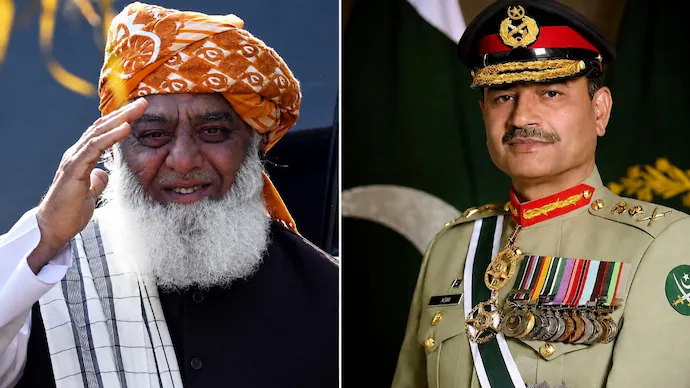
“If you want to do politics, then take off the uniform and come; participate in the elections, and it will become clear how many votes those in uniform receive.” With these words, Maulana Fazlur Rehman, chief of one of Pakistan’s largest political parties, the Jamiat Ulema-e-Islam (JUI-F), has become one of Pakistan’s most significant political figures to openly challenge the de facto political dominance of Pakistan by Field Marshal Asim Munir and the military’s outsized influence over the country’s politics.
Fazlur Rehman is the son of Mufti Mahmud, founder of the Jamiat Ulema-e Islam party, and former Chief Minister of the North-West Frontier Province (now called Khyber Pakhtunkhwa). One of Pakistan’s most influential Islamist politicians, Rehman has repeatedly called for the imposition of Sharia law and has long been associated with the Afghan Taliban, maintaining close ties with the Islamic Emirate of Afghanistan.
Rehman has also been among the country’s most vocal civilian critics of the military’s dominance in Pakistan’s politics. He made his political debut as part of the Movement for the Restoration of Democracy (MRD), a multi-party alliance formed to oppose General Zia-ul-Haq’s military dictatorship.
This is far from Rehman’s first tango with Munir. In December last year, he condemned Islamabad’s strategy of carrying out cross-border strikes inside Afghanistan against militant groups such as the Tehreek-e-Taliban Pakistan (TTP).
Here’s all you need to know about the pro-Taliban maulana who has challenged Pakistan’s all-powerful Field Marshal to shed his uniform and contest elections.
WHO IS MAULANA FAZLUR REHMAN?
Maulana Fazlur Rehman (born June 19, 1953, in Abdul Khel, Dera Ismail Khan) is the son of Mufti Mahmud, a prominent Deobandi cleric and politician who served as Chief Minister of the North West Frontier Province (now Khyber Pakhtunkhwa) from 1972 to 1973.
According to a report by the BBC, Rehman received early religious education at local madrassas and later studied at institutions including Darul Uloom Haqqania in Akora Khattak. Following his father’s death in 1980, the young Rehman (then in his late 20s) took over leadership of the Jamiat Ulema-e-Islam (JUI).
The party split in the mid-1980s into JUI-F (Fazl) and JUI-S (Sami-ul-Haq) factions, partly over differing attitudes toward General Zia-ul-Haq’s military dictatorship. According to a report by the Pakistani newspaper, Dawn, Rehman’s faction joined the multi-party Movement for the Restoration of Democracy (MRD) opposing Zia’s military dictatorship and faced arrests during that period.
Rehman was first elected to Pakistan’s National Assembly in 1988 by Dera Ismail Khan. He has since then won at least six more parliamentary terms.
His party, the JUI-F, draws much of its support from the Pashtun-majority districts of Khyber Pakhtunkhwa and Balochistan provinces, where its network of madrassas and religious institutions gives it significant grassroots influence. In the 2024 elections to the National Assembly, the party won 11 seats, while Rehman won from NA-265, a newly created constituency in Balochistan.
MAULANA FAZLUR REHMAN’S PRO-TALIBAN, ISLAMIST STANCE
Maulana Fazlur Rehman has long been a vocal supporter of the Afghan Taliban. Since the mid-1990s, his JUI-F party has provided ideological backing to the movement, while many Taliban leaders studied at JUI-affiliated madrassas in Pakistan, reported Dawn. He opposed Pervez Musharraf’s support for the 2001 US invasion of Afghanistan, leading anti-American and pro-Taliban rallies in major Pakistani cities.
Following the Taliban’s return to power in 2021, Rehman repeatedly called for international recognition of the Islamic Emirate of Afghanistan. According to reports by Dawn and the BBC, he has met senior Taliban leaders multiple times, including its reclusive supreme leader Hibatullah Akhundzada, and urged Pakistan to deepen ties with Kabul.
Even though ties between Kabul and Islamabad are currently at an all-time low thanks to both sides exchanging drone and airstrikes and accusations of supporting terrorists, Rehman has continued to call for both sides to engage in diplomacy.
Rehman has also consistently advocated for greater implementation of Sharia law in Pakistan. During JUI-F’s rule in Khyber Pakhtunkhwa from 2004 to 2007, the party backed the passage of the Hasba Bill to enforce Islamic moral codes, though it was later struck down as unconstitutional by the Pakistan Supreme Court. However, Rehman has rejected the use of armed struggle to impose Sharia, arguing that it is un-Islamic and fuels extremism, reported the online news outlet, The News Pakistan.
HOW MAULANA FAZLUR REHMAN WENT FROM PAVING THE WAY FOR ASIM MUNIR’S RISE, TO OPPOSING HIM
Although Maulana Fazlur Rehman is now directly challenging Asim Munir’s dominance, he ironically played a key role in the downfall of Imran Khan’s Pakistan Tehreek-e-Insaf (PTI) government in 2022 that paved the way for Munir’s rise. For context, in 2019, when Khan had abruptly sacked Munir as head of the Inter-Services Intelligence (ISI) after only eight months on the job.
Following the formation of the Pakistan Democratic Movement (PDM) in 2020 as a broad opposition alliance against Khan (who came to power in 2018), Rehman aligned JUI-F with the movement and was unanimously elected its president. He helped lead the coalition’s efforts, culminating in a successful no-confidence vote that removed Khan as prime minister in April 2022.
Rehman’s relationship with the PDM later deteriorated. After the formation of a coalition government led by Prime Minister Shahbaz Sharif of the PML-N, differences emerged over policy, power-sharing, and governance approach.
By late 2022 and into 2023, Rehman distanced JUI-F from the ruling arrangement, criticised the government, and shifted toward an independent opposition role.
Meanwhile, Munir, who had been sacked by Imran Khan as the head of the ISI, was appointed as the Chief of Army Staff (COAS) in 2022 by the PML-N coalition government that had taken power after Khan’s downfall.
In 2024, the PML-N and PPP coalition government, which had taken power after elections to the National Assembly that year, extended Munir’s tenure as COAS until 2027. And in 2025, in the aftermath of Operation Sindoor, Munir was promoted to Field Marshal, and later appointed the Chief of Defence Forces.
In December last year, Rehman had criticised Pakistan’s military leadership, specifically targeting Army chief Asim Munir and the country’s policy toward Afghanistan. He especially called out Munir and the Pakistani military regime’s contradicting stands on its actions against Afghanistan and India’s actions taken under Operation Sindoor on its territory earlier this year.
And on Sunday, July 12, while addressing a public gathering, Rehman accused the military of interfering in political affairs and questioned its growing role beyond defence and security matters, while claiming that the Pakistani state was losing control of the restive province of Balochistan. “There were insurgencies in the Baloch areas of Balochistan. The entire Baloch region had slipped out of Pakistan’s control. Even today, the writ of the Pakistani government does not exist there,” he said.
For now, the Maulana remains one of Pakistan’s most significant political figures to stand up to the dominance of the Field Marshal. How long he keeps it up, remains to be seen.