
From Rs 1,000 to Rs 600: Earnings of Delhi’s e-rickshaw drivers hit by Bluetooth hack

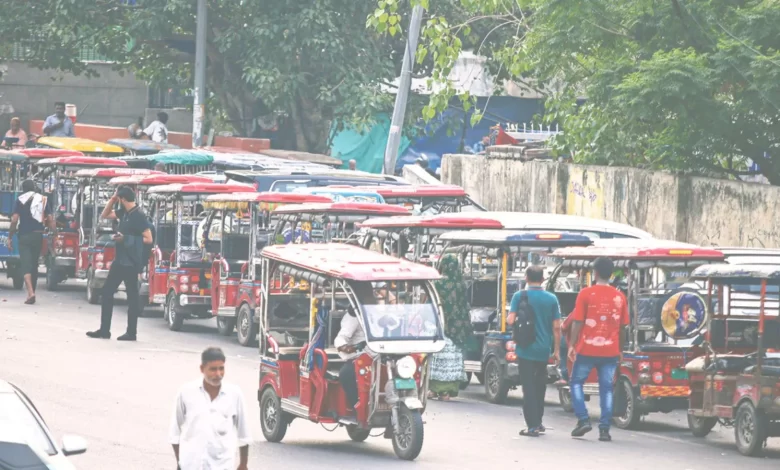
On Wednesday, 20-year old Anu Kumar’s e-rickshaw stopped in the middle of the road in front of Bangla Sahib Gurdwara. He tried switching it on multiple times, but to no avail. A long line of angry drivers kept honking behind him.
By the time a couple of kind strangers helped him push the e-rickshaw to the roadside, his passengers had left, and that too without paying. “No one will pay if you drop them before their destination,”he said.
Kumar took the e-rickshaw to a mechanic, afraid how much he will have to shell out to get it fixed.
But the mechanic just opened an app and tapped on the screen, and to his relief, the vehicle whirred back to life.
But the relief was short-lived. His rickshaw stopped the same way three more times the same day. On Thursday, too, it shut down thrice. “I went home. What can you do when your vehicle stops three times in a day?” Kumar is not alone.
For the last three days, e-rickshaw drivers in the Capital have found themselves at the mercy of strangers using Bluetooth-enabled mobile applications to connect to their vehicles’ battery management systems (BMS) and remotely switch them off, stopping their vehicle dead in the middle of the road.
On Friday, the Union government directed Apple and Google to remove at least three battery-management apps – BAT-BMS, Lossigy and Epoch Li-ion – from their app stores following reports that they were being misused.
Drivers, meanwhile, are a harried lot. “I usually earn Rs 1,000 a day. After paying for charging and maintenance, I am left with about Rs 800.
But for the last two days, I have earned only Rs 600-700 because my vehicle was stopped four times each day,” said Mukhiya Yadav (24), who operates between Chuna Mandi and Ram Manohar Lohia Hospital.
“While some people demanded Rs 200 to restart the vehicle, yesterday, one person even asked me for a beer,” he added.
By Friday, Yadav had downloaded the BAT-BMS app himself and was helping stranded drivers restart their e-rickshaws.
The BAT-BMS app was originally developed by China’s Shenzhen Grenergy Technology as a legitimate battery management tool for Bluetooth-enabled lithium-ion batteries. It allows users to monitor a battery’s state of charge, voltage, current, temperature, charging cycles and overall health. The app can connect wirelessly to batteries over Bluetooth Low Energy (BLE) within an operating range of around 15 m.
The primary concern, however, lies with the security configuration of some BMS used in low-cost electric vehicles. A BMS is the electronic controller that monitors and protects lithium-ion battery packs by regulating charging, discharging, temperature and cell balance. The apps in question could connect to the BMS within a limited range, and be used to cut battery power, bringing the vehicle to a sudden halt.
“This is a matter of security, and to ensure that people do not face inconvenience or distress, the government will certainly take appropriate action… The Transport department is also investigating and checking the matter,” Delhi Transport Minister Pankaj Kumar Singh said, adding that Delhi Police was conducting an inquiry into it.
Kishori Kumar Jha (55), who drives it in West Delhi’s Ramesh Nagar, said, “People in cars and young boys have been
troubling us continuously for the last two days. After my e-rickshaw stopped yesterday, someone came up to me and demanded Rs 500 to restart it. This is extortion.”
Rajiv Tuli, General Secretary of Electric Vehicle Manufacturing Society (EVMS), said complaints started pouring in from Wednesday.
“We started receiving complaints from drivers across Delhi the day before yesterday. Manufacturing companies have set up helplines where stranded drivers can call and get assistance on how to restart their vehicle. Manufacturing companies have also made their own apps now which drivers can use,” he said.