

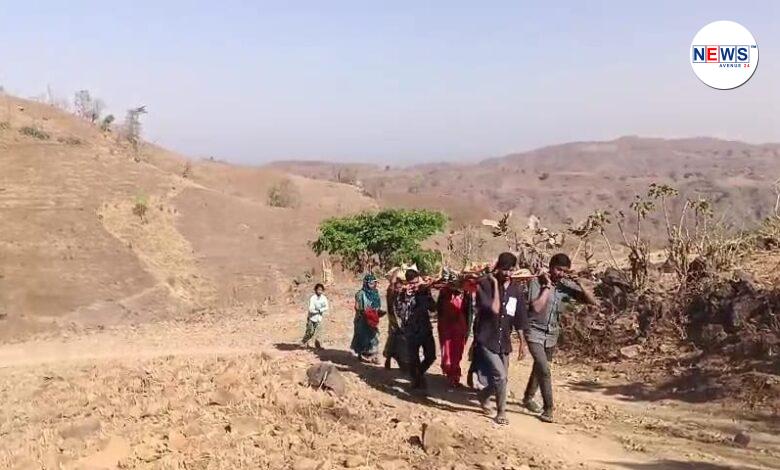
Pregnant woman’s death, High Court intervention and a government promise: Gujarat tribal village waits for a road nearly 2 years later

The road to Baskariya faliya in Turkheda village of Gujarat’s Chhota Udepur, a tribal district, does not really end, it simply disappears.
Just about two kilometres after turning in from the main road towards the rugged hillside where the village lies, the narrow dirt track shrinks into a winding trail of loose mud and jagged stone curling around barren mountainsides. The deeper one goes into the hills, the vehicles are fewer and even motorcycles cannot ride this path. The final stretch to 32-year-old Kishan Bhil’s home can be reached only on foot.
It was along this very mountain path, before dawn on October 1, 2024, that villagers had carried Kishan’s pregnant wife, Kavita, on a makeshift cloth stretcher tied to bamboo poles after she developed labour pains. The nearest point where a 108 ambulance could reach was almost five kilometres away. Kavita died before that, but not before bringing to the world a baby girl.
A year later, on September 16, 2025, a 36-year-old pregnant woman, Vansi Nayak, was similarly carried on a cloth stretcher for five kilometres till the ambulance, which took her to the local hospital and then the Vadodara SSG hospital where she died.
On one side of the mountain track, crumbling gravel slopes cling to the edge of the hill. On the other hand, there is a steep valley, dotted with mud homes and isolated tribal hamlets. There are no railings, no retaining walls, no drainage channels, no signages; only the tyre marks on the dusty road trace the fragile connection between Turkheda’s interior faliyas (housing cluster) and the outside world.
In summer, the trail is harsh and rocky. But villagers say the real fear arrives with the monsoon. Within weeks from now, rainwater will turn the pathway into a slippery stream of mud where even two-wheelers are abandoned midway. The six-km journey to the nearest motorable main road – and onward to Kawant town – becomes uncertain, especially at night or during medical emergencies.
Unkept promise
Kavita’s tragic death triggered outrage across Gujarat and prompted the Gujarat High Court to take suo motu cognisance of The Indian Express report detailing her death. Soon after, the state government announced “immediate” construction of an eight-kilometre tar road connecting Turkheda’s scattered hamlets at an estimated cost of Rs 13.5 crore. The Roads and Buildings Department approved the project, promising paved roads and protection walls through the mountainous terrain, however, it awaits clearance from the state forest department.
Inside Kishan’s bamboo-and-mud home today, their baby girl — Priya– toddles near the doorway, reaching toward her older siblings — Veeral (7), Avinash (4) and Ria (2.5). Hanging on the wall above them is a garlanded photograph of Kavita, with the date of her death printed beneath her young face. The children have little memory of their mother.
“I have somehow managed these two years with the help of my parents and sister,” Kishan says. “But the reality of our lives is that ambulances still cannot enter the interior faliyas.”
Recalling that night, his voice trembles.
“Kavita experienced labour pain at night. Had it been the daytime, we would have managed. Unfortunately, that night, Ramesh and his pick up tempo were unavailable too. It was impossible to take her on the motorcycle on that path… The neighbours gathered like they always do during emergencies. We tied cloth to bamboo poles and carried her towards the ambulance point across the uneven hills. We never imagined she would die on the way. Barely a kilometre into the walk, she delivered a baby girl and died. It left me numb.”
Ramesh Bhil is the only Turkheda resident who owns a tempo and he takes people to the town when he goes to work. But during monsoon, even that ride is a risky affair.
Nearly two years later, the road remains unbuilt and for the villagers another monsoon without the road feels like another countdown to tragedy. The fears have been deepened following the death of Vansi Nayak.
Jayanti Bhil, whose wife Vasanti is the Sarpanch of the village, tells The Indian Express that despite multiple memoranda given to the Chhota Udepur District Collector, the project has not been prioritised. “We have been told that the forest department has not granted permission for the project… But even the forest department needs the road… Until the road is constructed, many women stare at a similar fate as that of Kavita and Vansi…”
Jayanti says there is no school in Turkheda’s faliyas. “The nearest primary school is nearly 10 kilometres away across the hills, forcing families to either send children away to residential hostel schools in Kawant or abandon their education altogether… The road project needs to be expedited. We are surprised that it has not been done even after the Gujarat High Court took suo motu cognisance of the case… We have seen two women die in two consecutive years…”
Among villagers, the legal proceedings that followed Kavita’s death have also become part of village memory, even if most residents do not fully understand them. Villagers refer to the Gujarat HC taking “suo motu” action — that had briefly raised hopes that the long-awaited road would finally become reality.
An old villager says, “We know that the case proceeded because the Court had expressed shock and directed the road to be built as soon as possible… But the administration has brought us to the doorstep of another monsoon without any execution of the court directive…”
Kishan, who is planning to enrol Veeral in a residential school in Kawant this year, agrees, “Having lost my wife, I can only hope no other family and children have to go through this. Sometimes I think if my children were older they would have felt more pain than they do now… because they have no memory of their mother to feel the pain that I feel. I am concentrating on ensuring they are sent to school as the time comes…”
Kishan, a farmer, says he has not yet contemplated on the prospect of remarrying because of the tribal customs.
What officials say
Officials of the District R&B department, who spoke to this newspaper on conditions of anonymity, said that a clubbed proposal to build seven rural roads connecting different remote tribal hamlets in Kawant is currently awaiting final forest and revenue clearance. According to officials associated with the project, the proposed roads will be constructed from the available grants under the Mukhya Mantri Gram Sadak Yojana’s Tribal grants head.
An official told this newspaper, “All seven road alignments pass through forest land, requiring a multi-stage approval process involving both the Forest and Revenue Departments. Together, the projects require more than 15 hectares of land. Under the process, the Revenue Department of the state government must first identify and allot equivalent land for the forest department… The R&B department has already submitted its request, and the proposal is currently pending final approval at the state government level..”
Officials added that the forest department has also made simultaneous applications through the Centre’s Parivesh portal (Pro-Active and Responsive facilitation by Interactive, Virtuous and Environmental Single-window Hub) – the online system used for forest and environmental approvals. “Because the total land requirement exceeds 15 hectares, the proposal has been escalated beyond the state level for approval by higher forest authorities… The Forest Department has completed its part and forwarded the proposal for approval. Once we receive in-principle approval, the required charges will be paid and permission to begin work will be granted,” an official said.
The process also involves payment to the Revenue Department based on jantri rates — the government valuation of land — apart from separate compensatory charges payable to the Forest Department. The official added that about two kilometers out of the 8 kilometre stretch of Turkheda’s faliyas were constructed earlier last year.
This stretch is the entry point of Handlabari faliya while the remaining 6.8 kilometre stretch from Baskariya faliya — the farthest– as well as Girmatiya Amba faliya is yet to be constructed.
“The dusty trail was widened when the work began to construct the Handalbari faliya road… However, the 4m-wide dusty trail will be a challenge in the monsoon… When constructed, the road will be 3.75 meters wide,” the official said.
The other inaccessible villages, which are also awaiting approval to proceed with constructing roads to connect to the main road, include a 4.5-km stretch from Kotbi Savda faliya of Turkheda — where the primary school lies and a 4.9-km road from Hafeshwar Mahudibari faliya as well as two roads in Amba Dungar area– from Manukla faliya and Mathamahuda faliya. Two other roads in Khasra-Jally faliya as well as Kelbari faliya are of 2.4km and 1.5 km, respectively.
The official added that the hilly terrain of the region has meant that the cost escalation has been factored in, especially since the capacity of the vehicles deployed for material transportation can only carry half the quantity of the raw materials due to the tough terrain. “During the small patches that we constructed, we realised that a vehicle that has a capacity to carry 28 tonnes of raw material was only able to carry 14 tonnes…” the official said.
Maternal mortality rate still high in Gujarat
In reply to an unstarred question in the Rajya Sabha, Union Minister of State of the Ministry of Health and Family Welfare Anupriya Patel stated that Gujarat stood at the fifth position in the country for progress made in declining Maternal Mortality Ratio (MMR). As per the data of the Ministry, From 75 maternal deaths per 1 lakh live births in 2016-18, Gujarat saw an MMR of 55 in 2020-22. India’s MMR stands at 88.