

Traditional Healers Play Vital Role Amid Ebola Outbreak In Eastern Democratic Republic Of Congo

In her garden, traditional healer Mariam Kabika looked for ingredients for a concoction to treat Ebola, a deadly virus spreading in the eastern Democratic Republic of Congo.
“I’m looking for eucalyptus leaves, avocado leaves, mango leaves and papaya leaves,” said Kabika, a healer in the city of Bunia, the capital of Ituri province, at the centre of the latest Ebola outbreak.
Ituri lies in the east of the vast country, a mineral-rich but poor region ravaged by decades of conflict where state services are largely absent.
The Ebola outbreak, which was declared on May 15, is the central African country’s 17th.
So far, it is confirmed to have infected 359 people, including 61 who died, according to the World Health Organization (WHO).
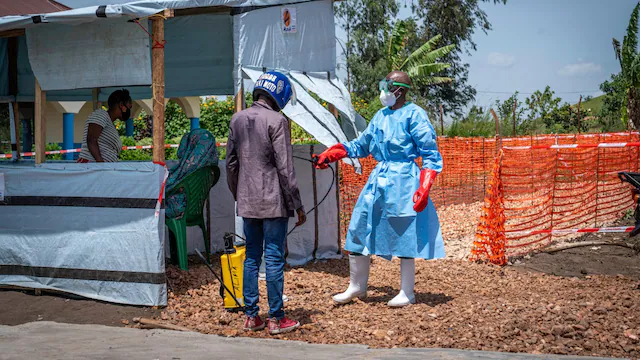
Health workers arriving to respond to the Ebola outbreak often run into deep mistrust from the local population.
Traditional healers, who live among the locals and enjoy their trust, find themselves on the front lines of the fight against a disease that is passed on through close contact and bodily fluids.
While there is no vaccine or treatment for the Bundibugyo strain responsible for the current flare-up, Kabika and her husband, Dauda Tshimanga, claim to have developed a cure.
- Ancestors’ laboratory –
The couple’s practice in a thatched hut is cluttered with amulets, perfume to ward off evil spirits and herbal brews.
“The laboratory of the ancestors,” they call it.
“If the patient does not get better with the plants we have prepared, we bring them into this laboratory to invoke the spirits and ask the ancestors for help,” Tshimanga said.
On the wall, painted in red letters, are the various afflictions the pair say they can treat: “Sexual weakness, typhoid, hernia…” And now Ebola.
Tshimanga claims he can treat Ebola with an inhalation of boiled plants, taken morning, noon and night for three days.
Since the start of the latest outbreak, no patient has yet tried the treatment, but during previous outbreaks, “we cured many people who came in bleeding, with fever,” he said.
“Traditional medicine has not yet been brought in for the treatment and response to this disease, but we are ready to contribute,” Tshimanga said.
- Trad-healers –
The couple are what’s known in the DRC as tradi-practitioners, a profession that is not officially recognised in the country, although it is regulated and, in theory, licensed.
Health infrastructure can be crumbling or non-existent in the eastern DRC where diseases are often thought to be the result of a poisoning by an enemy, a neighbour, colleague or relative.
So, people turn to local healers for help.
Some Ebola patients “believe they are victims of poisoning and consult tradi-practitioners, who give them traditional remedies without dosage or supervision,” Willy Beiza, a doctor in Bunia, told AFP.
Traditional remedies delay the real diagnosis and medical care of patients, who “are brought to our health facilities in critical condition”, he lamented.
- Effective response –
WHO chief Tedros Adhanom Ghebreyesus, who visited Bunia last weekend, told reporters in Geneva that “community mistrust” was high.
“Some community leaders told me that they believe Ebola is not real,” he said.
In a remote region plagued by armed groups, where health workers are shunned, traditional healers can play a key role.
The WHO says that an effective response to Ebola relies on integrating communities and “their rites”.
During an Ebola outbreak last year, traditional authorities and ancestral practices made it possible to involve communities in the response, according to the WHO.
Traditional leaders, for example, used an isolation ritual to quarantine suspected cases and banned the washing of bodies and the collection of dead animals.
For now, the response to the current surge has been slow to take shape.
“Only about 45 percent of contacts have been followed up,” the WHO has said.
“We are asking tradi-practitioners to refer patients to health centres and we are in the process of distributing protective equipment to them,” Marie Roseline Belizaire, head of emergencies for WHO in Africa, said.
As healer Tshimanga in Bunia put it: “The Ebola outbreak is real and it kills people. We must not take it lightly.”