

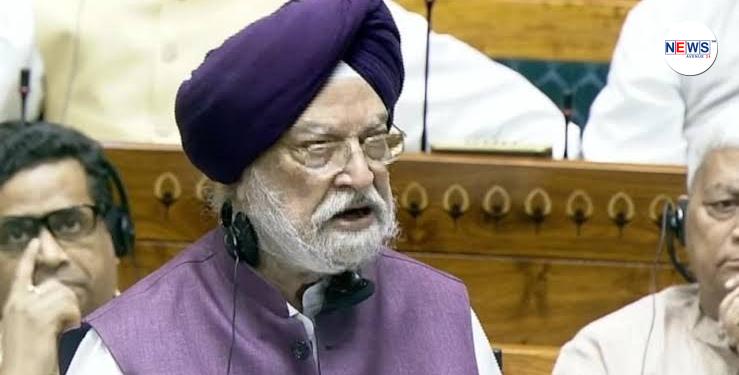
India has diversified LPG sources, says Hardeep Singh Puri amid panic over supply

India has “actively” diversified its liquefied petroleum gas (or cooking gas) imports to alternate suppliers such as the US, Norway, Canada, Algeria, and Russia, in addition to available Gulf sources, petroleum minister Hardeep Singh Puri told Parliament on Thursday.
“It should be noted that India was previously importing approximately 60% of its LPG requirements from Gulf countries such as Qatar, UAE, Saudi Arabia, and Kuwait and 40% is produced domestically. Procurement has now been actively diversified, with cargoes being secured from the United States, Norway, Canada, Algeria, and Russia, in addition to available Gulf sources,” he said in the Lok Sabha in a statement.
Informing the House about the ministry’s steps in response to the disruption to global energy supply arising from the ongoing conflict in West Asia, Puri said: “The world has not faced a moment like this in modern energy history. Today is the 13th day since the passage through the Strait of Hormuz, through which 20% of world’s crude, 20% of world’s natural gas and 20% of the world’s LPG flows, was disrupted following the military operation between Iran, Israel and the US.”
The minister assured the House that India’s crude supply position is secure. “Volumes secured exceed what Hormuz would have delivered. Before this crisis, approximately 45% of India’s crude imports transited the Hormuz route. Thanks to Hon’ble PM’s outstanding diplomatic outreach and goodwill, India has secured crude volumes that exceed what the disrupted Strait route would have delivered in the same period,” he said.
“Non-Hormuz sourcing has risen to approximately 70% of crude imports, up from 55% before the conflict began,” he said. India sources crude from 40 countries, against 27 in 2006-07. Diversified sourcing gave New Delhi options to meet its requirements and Indian refineries are operating at “high capacity utilisation” with some exceeding 100%, he said. “There is no shortage of petrol, diesel, kerosene, ATF or fuel oil.”
A petroleum ministry official, requesting anonymity, said none of the retail outlets in the country is dry. As on September 30, 2025, India has 99,281 retail outlets with 28,533 in rural areas.
Puri said the government is managing natural gas supply through prioritised allocation, and the position is “stable well beyond immediate need”. India produces about 90 Million Metric Standard Cubic Metres per Day (MMSCMD) of natural gas domestically and consumes about 189 MMSCMD, the official said. Import of about 30 MMSCMD through Gulf sources are currently affected by the force majeure declaration from a major Qatari processing facility.
Citing the Natural Gas Control Order of March 9 under the Essential Commodities Act, Puri said the government has established an immediate priority sequence. “Domestic piped gas to homes and CNG for vehicles receive 100% supply with no cuts,” he added. Industrial and manufacturing consumers will receive up to 80% of their previous six-month average. Fertiliser plants will receive up to 70%, protecting the agricultural input chain ahead of the sowing season. Refineries and petrochemical units absorb a managed reduction, with that gas redirected to higher-priority sectors, he added.
“I am pleased to inform the House that the shortfall has been substantially offset through alternative procurement. Large LNG cargoes are arriving on an almost daily basis through alternative supply routes, and India has sufficient gas production and supply arrangements to sustain this position even in the event of a prolonged conflict. Power generation for every household and for industry is fully protected.”
While India has diversified procurement, a LPG Control Order was issued on March 8 directing all refineries to maximise LPG yields and channel the entire output exclusively to the three oil marketing companies for domestic cooking gas, he said. “Hence, in the last 5 days, LPG production has been increased by 28% through refinery directives, and further procurement is actively underway,” he said.
To be sure, three state-run OMCs – Indian Oil Corporation (IOC), Bharat Petroleum Corporation Ltd (BPCL) and Hindustan Petroleum Corporation Ltd (HPCL) have near monopoly in fuel retail business. As October 1, 2025, the three OMCs together have 33.1 crore active LPG customers in the domestic category who are being served by 25,584 LPG distributors.
“Modi Govt’s foremost priority is that the kitchens of India’s 33+ crore families, especially the poor and the underprivileged, do not face any shortage. Domestic supply is fully protected and the delivery cycle is unchanged. The standard time from booking to delivery for domestic LPG cylinders remains 2.5 days, unchanged from pre-crisis norms,” the minister said.
“Hospitals and educational institutions have been placed on uninterrupted priority supply; their access to LPG is fully assured regardless of broader demand conditions. Field reports indicate hoarding and panic-booking at the distributor and retail level, driven by consumer anxiety rather than any actual supply shortage,” he added.
He said commercial LPG has been regulated to prevent black marketing, not to penalise the hospitality sector. “Commercial LPG is sold in a completely deregulated, over-the-counter market at market price, without any government subsidy. There is no registration system, no booking requirement, no digital authentication, and no delivery confirmation mechanism. Any business or individual can purchase cylinders in any quantity at the point of sale, with no government control in normal times. In a supply-constrained environment where public anxiety is elevated, this deregulated structure creates a direct and uncontrolled pathway for hoarding, diversion, and resale at inflated prices. Had commercial supply been left entirely unrestricted, cylinders purchased over the counter could have been diverted to the grey market at the expense of genuine commercial consumers and domestic households alike,” he said.
The government has therefore taken the responsible course: to regulate this channel with clear priorities and a transparent allocation mechanism, he said. “A three-member committee comprising Executive Directors from IOCL, HPCL, and BPCL was constituted on 9 March 2026. Extensive meetings have been held with state civil supply departments and restaurant associations across the country and are continuing,” he said.
The committee has assessed genuine need by geography and sector to ensure available commercial volume reaches genuine users first. In a major decision, 20% of the average monthly commercial LPG requirement will be allocated from today by OMCs, in coordination with the state governments so that there is no hoarding or black marketing, he said. The minister informed the House about alternate fuel options such as kerosene, biomass, RDF pellets, and coal for the hospitality and restaurant segment for one month. It would enable a wider range of establishments to switch and free up LPG for priority consumers, he said.
“This is not the moment for rumour-mongering or fake narratives. India is navigating the most severe global energy disruption in recorded history. Crude supply is flowing. Gas is prioritised for homes and farms. LPG production has been stepped up by 28 per cent. Consumer prices are held far below what markets and regional comparators would dictate. Schools are open. Petrol is on the forecourt. Every citizen, regardless of political affiliation, has a stake in that. India must stand united behind its energy warriors, behind the institutions managing this crisis, and behind the national interest,” he said in the House.