

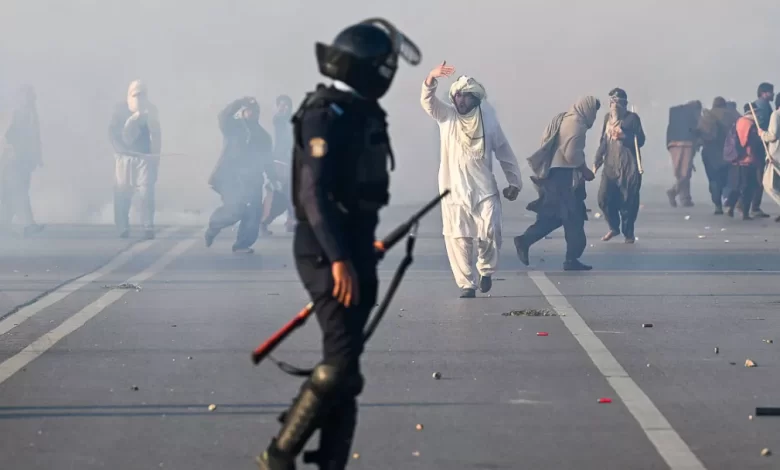
Political Revolt, Separatist Surge, Economic Distress: Pakistan Battles Crisis On Multiple Fronts

Pakistan is confronting mounting pressure on several fronts as political confrontation, separatist movements, militant violence, economic distress and security crackdowns deepen concerns over the state’s ability to maintain control.
From Gilgit-Baltistan in the north to Gwadar in the south, the country is witnessing growing public discontent, friction between political forces and the military establishment, and increasing challenges to federal authority.
While official circles maintain that state institutions remain functional and the situation is being handled within constitutional limits, critics, analysts and human rights observers warn that structural cracks are widening across Pakistan.
Political And Institutional Confrontation Deepens
One of the most significant challenges facing Pakistan is the escalating confrontation between major political groups and the military establishment.
Pakistan Tehreek-e-Insaf (PTI), led by jailed former prime minister Imran Khan, has maintained an openly hostile position towards the military leadership. Khan’s family and senior PTI leaders have repeatedly accused the establishment of engineering his removal from power, suppressing the party and denying it its electoral mandate.
The continuing standoff has intensified political polarisation in Khyber Pakhtunkhwa and across the federal landscape, leaving little room for reconciliation between PTI and the current power structure.
Analysts warn that the prolonged confrontation between elected representatives, opposition parties, the judiciary, the bureaucracy and the military could lead to institutional paralysis as each side disputes the constitutional limits of the other.
Fazlur Rehman Opens New Front Against Military
Jamiat Ulema-e-Islam-Fazl chief Maulana Fazlur Rehman has also adopted an increasingly confrontational position towards Pakistan’s military leadership.
Traditionally seen as a pragmatic political player capable of negotiating with both civilian governments and the establishment, Rehman has publicly criticised Field Marshal Asim Munir and questioned the military’s security policies and handling of Pakistan’s internal crises.
His influence among religious groups and communities along the Pakistan-Afghanistan border makes his defiance particularly significant. Political observers believe his criticism has opened another difficult front for the ruling coalition and the military establishment.
The JUI-F chief’s aggressive speeches in Parliament and at public rallies have also revived discussion around an allegation made by former CIA officer Sarah Adams.
Adams had claimed that a so-called “FATA-War Plan” involved an alleged understanding between the Afghan Taliban, Al-Qaeda and Fazlur Rehman to destabilise Pakistan and facilitate the creation of an independent Pashtunistan.
Rehman’s escalating rhetoric and mobilisation in sensitive border regions have prompted some analysts to question whether his campaign is merely intended to pressure the government or represents a broader political realignment.
Pashtun Nationalism Challenges Federal Authority
The Pakistani state is also facing sustained resistance from Pashtun nationalist groups in Khyber Pakhtunkhwa and the former tribal areas.
The Pashtun Tahafuz Movement, led by Manzoor Pashteen, has mobilised supporters around allegations of enforced disappearances, extrajudicial killings, military excesses and discrimination against Pashtuns.
The movement’s opposition to the Durand Line as a permanent international border reflects deeper ethnic and geopolitical tensions surrounding the Pakistan-Afghanistan frontier.
The issue has become more sensitive amid strained relations between Islamabad and the Taliban administration in Kabul, as well as continuing militant attacks attributed to the Tehreek-e-Taliban Pakistan.
Baloch Insurgency Expands Pressure On State
In Balochistan, separatist groups, particularly the Baloch Liberation Army, have intensified attacks on security personnel, infrastructure and state-linked projects.
The insurgency has placed increasing pressure on Pakistan’s security forces and exposed the state’s limited administrative reach in remote rural areas.
Baloch nationalist groups accuse Islamabad of exploiting the province’s natural resources while denying local communities political rights, economic opportunities and control over development projects.
The deepening alienation has also complicated security and infrastructure operations around Gwadar, a strategic port and a central component of the China-Pakistan Economic Corridor.
As attacks become more coordinated and frequent, concerns are growing that the state is struggling to restore lasting control beyond major urban and military centres.
Sindhudesh Movement Raises Water And Rights Issues
Separatist sentiment is also visible in Sindh, where groups associated with the Sindhudesh movement advocate the creation of an independent homeland for the indigenous Sindhi population.
Supporters of the movement accuse the federal government and Punjab-dominated institutions of discriminating against Sindh in government recruitment, resource allocation and the distribution of river water.
Although the movement remains politically fragmented, disputes over water, provincial autonomy and demographic change have helped sustain resentment against the federal government.
PoK Protests Fuel Calls For Independence
Pakistan-occupied Kashmir has witnessed an unprecedented wave of unrest, with protesters accusing Islamabad and the military establishment of repression, economic neglect and the denial of basic rights.
Leaders associated with the Joint Awami Action Committee have demanded accountability for the deaths of protesters, the return of bodies allegedly withheld by the authorities and the release of detained activists.
During the agitation, a JAAC leader also appealed for Indian assistance, seeking medical supplies and food amid what he described as a military siege.
The leader called for the removal of restrictions along parts of the Line of Control and warned that residents could attempt to cross into India if Pakistani forces opened fire on demonstrators.
The appeal marked a sharp escalation in the agitation and reflected the extent of anger against Pakistan’s administrative and military control in the region.
Crackdown In Gilgit-Baltistan And PoK
Pakistan has simultaneously tightened surveillance and security measures in Gilgit-Baltistan and Pakistan-occupied Kashmir.
Human rights activists, including Senge Sering, have accused the authorities of using stringent security laws, arrests, communication restrictions and intimidation to suppress dissent.
Observers say the regions’ sensitive geopolitical position is frequently cited to justify measures against activists, political leaders and civil society groups.
Critics warn that such actions could deepen public alienation rather than prevent unrest, particularly when residents already feel excluded from political and economic decision-making.
‘Stolen Mandate’ Allegations Haunt Government
Pakistan’s political crisis also continues to be shaped by allegations that the February 2024 general election was manipulated to prevent PTI-backed candidates from securing power.
PTI leaders and independent observers have alleged major discrepancies between Form 45, which records results at individual polling stations, and Form 47, which contains consolidated constituency results.
Opposition parties claim that PTI-backed candidates were leading on the basis of polling-station records before communication disruptions and delays in the announcement of final results.
They allege that consolidated results were subsequently altered to reverse those leads and install candidates favoured by the establishment.
The Pakistani government and election authorities have rejected allegations of systematic manipulation. However, the controversy has continued to undermine the legitimacy of the ruling arrangement and strengthen PTI’s campaign against the military establishment.
Economic Distress Fuels Public Anger
The political and security crises are unfolding against the backdrop of severe economic distress.
Inflation, unemployment, poverty, electricity costs and declining purchasing power have intensified anger against the government and state institutions.
For many Pakistanis, the economic crisis has reinforced the belief that the political system is consumed by elite power struggles while ordinary citizens bear the cost.
Analysts warn that the combination of economic hardship, militant violence, nationalist movements, political repression and institutional confrontation could push Pakistan towards a wider period of civil unrest.
The state now faces the difficult task of securing volatile regions, restoring political legitimacy and managing public anger while its principal institutions remain locked in an increasingly bitter struggle for power.