

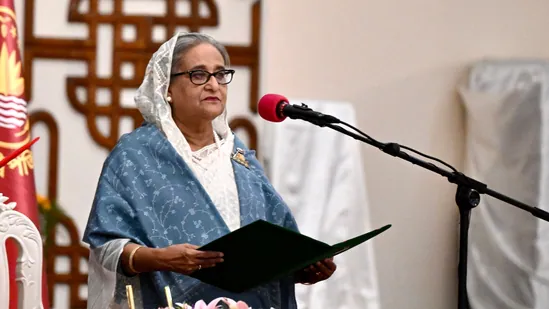
Will India have to send Sheikh Hasina on Bangladesh’s extradition request? What treaties say

The fate of Sheikh Hasina, former Bangladesh prime minister in exile in India, remains uncertain after a tribunal court in her country on Monday awarded her death penalty in connection with the deadly violence in the student-led uprising last year.
The International Crimes Tribunal (ICT) on Monday gave death sentence to Sheikh Hasina, 78, for ordering the use of lethal force while cracking down on the protests last year in August, during which she fled to India. The ICT awarded a separate sentence of imprisonment until death to Hasina for being complicit in crimes against civilians by law enforcement and armed cadres of her Awami League party.
Since the sentence, what’s next for Sheikh Hasina remains, India’s response and the fairness of the trial and sentencing by the ICT remain among the key questions while the Bangladesh interim government asserted that the no one is above the law, seeking handing over of the ‘fugitive’ former PM by India.
Hasina, along with her former home minister Asaduzzaman Khan Kamal, who is also believed to be in India, was earlier declared a fugitive by the court
Sheikh Hasina’s extradition from India
India, responding to Sheikh Hasina’s death sentence, said on Monday it has taken note of the verdict delivered by the International Crimes Tribunal of Bangladesh and reaffirmed that it “remains committed to peace, democracy, inclusion and stability in Bangladesh”.
However, India did not comment on the request for Hasina’s extradition.
“India has noted the verdict announced by the ‘International Crimes Tribunal of Bangladesh’ concerning former prime minister Sheikh Hasina,” the Ministry of External Affairs said.
“As a close neighbour, India remains committed to the best interests of the people of Bangladesh, including peace, democracy, inclusion and stability in that country. We will always engage constructively with all stakeholders to that end,” it added.
An Indian government source cited in a said Reuters report said extradition is a lengthy process requiring review of tribunal documents to ensure due procedure, fair representation, and credible testimony.
India cannot act without these records, and exemptions to the treaty apply if the case appears political, the above-mentioned source said.
After the sentence was handed down, the Bangladesh interim government had told India that failure to return her would be “a highly unfriendly gesture and an affront to justice”.
“Under the existing extradition treaty between the two nations, this is a binding obligation for India,” Bangladesh’s foreign ministry had said in a statement.
What do rules in extradition treaties say
An extradition treaty between India and Bangladesh, signed in 2013 and amended in 2016, is based on the principle of dual criminality – meaning, the offence must be punishable in both countries.
While Hasina’s conviction meets procedural requirements, the dual-criminality clause allows India room to deny extradition if the charges do not align with India’s domestic legal definitions.
Article 2 of the treaty, accessed on mea.gov.in, lists the extradition offences and states: In determining whether an offence is an offence punishable under the laws of both Contracting States, it shall not matter whether the law of both Contracting States place the act or omission constituting the offence within the same category of offence or denominate the offence by same terminology”.
Article 8 further says a person may not be extradited if the accused proves the request is “unjust or oppressive”, including if the charges are trivial, not made in good faith, politically motivated, or if the person risks persecution.
Article 6 also permits refusal if the offence is of a “political nature”, although crimes like murder, terrorism, kidnapping or offences under multilateral treaties cannot be classified as political. Since the charges against Hasina – including murder, disappearance and torture – fall outside this exemption, it remains unclear if India will cite the political-nature clause.
Under Article 7, India may also decline extradition if it chooses instead to prosecute the accused.
India’s Extradition Act, 1962, also gives the Centre wide powers to deny extradition, stay proceedings or discharge the person sought.
Section 29 specifies that a request may be rejected if it appears trivial, not made in good faith, politically motivated, or not in the interest of justice. The Act also allows the government to halt proceedings or cancel warrants at any stage.
Sajeeb Wazed, son of Sheikh Hasina, calling Bangladesh’s extradition request “illegal” and expressed confidence that India will not act on it.
“I think they [the Indian government] know very well how to handle this extradition request. I don’t think the Indian government is going to respond to such an illegal request,” Wazed said in an interview with ANI news agency on Wednesday.
He said he has faith in the Indian democracy and its belief in the rule of law.