

To treat the living, doctors need to learn from the dead. Every year, thousands of medical students across India run their scalpels through tissues and organs, getting a first-hand understanding of human anatomy. That is how the dead become their first teachers, and also their first patients. Not just medical students, even trained surgeons try out novel, life-saving surgical procedures on cadavers.
I know there’s a critical shortage of cadavers not just in India, but across the world. While there has been a rise in donors, one wrong message can wipe out gains made over decades. So, when Sejal Pawar, a third-year medical student, cracked a joke on cadavers at comedian Pranit More’s show, infuriating most people, I thought of doing what journalists do — dive deep into the issue.
If you read on, you will find out how cadavers are received, preserved, used and disposed of in medical colleges in India. They do vary from state to state, and from one institution to another. But what doesn’t change is the respect that doctors are taught to have for body donors.
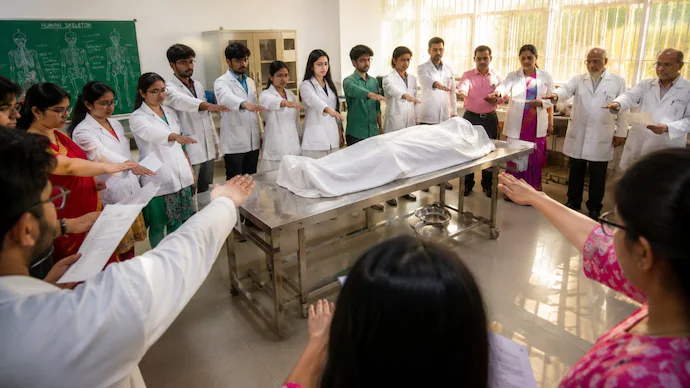
All medical students in India in the first year of their MBBS course take the Cadaveric Oath, which honours the sacrifice of the donor and their family, while pledging to “show due respect and gratitude to this cadaver who will always remain our first teacher”.
With over 800 medical colleges with close to 1.30 lakh MBBS seats, India tops the world in the number of such institutions. The increase in the number of medical colleges across the country has given rise to a demand for cadavers, which are essential for MBBS students.
The sight of a corpse or severed body parts can be unnerving. Then there is the nauseating stench of chemicals, especially of formalin. Students are in their teens still, and some faint in the dissection rooms. Disease, difficult deaths and cadavers aren’t easy to deal with at a young age, and might give birth to gallows humour. But everyone is mindful of the big sacrifice of the person lying on the table of the dissection room.
No one might know that more than Dr SB Ray, Professor and head of the department of anatomy at AIIMS New Delhi. He is also in-charge of the body donation programme at AIIMS, India’s foremost government hospital.
“I see them walking into my office, telling me they want to donate their bodies so that students can learn and serve people better. Then I see their bodies being brought in by relatives,” Dr Ray told India Today Digital.
CADAVERIC OATH AND RESPECT FOR THE DEAD AT MEDICAL COLLEGES
Anatomy is one of the foundational subjects of the MBBS course. Study of medicine would remain just theory if not for the cadavers. The gap in theory and practice would ultimately go on to impact clinical practice and patient care.
A shortage of donated bodies, at times in India, makes around 50 students peer over a single cadaver. In an ideal situation, a group of 5-10 students should get a cadaver each.
While AIIMS New Delhi gets around 50 to 60 donated bodies a year, scores of medical colleges in India might receive two to three cadavers a year at best. Though there is no statewise data readily available in public, media reports from different years suggest an acute shortage of cadavers at medical colleges.
Medical colleges prefer donated bodies over unclaimed cadavers. Most unclaimed bodies undergo autopsy, and the cuts make the preservative chemicals drain out. Also, the health profile and medical history of donors are known, making them ideal for research.
The concept of an afterlife, social and religious beliefs make body donation rare across the world.
“Doctors and students are very mindful that someone had donated their body for us to learn. Body donation is considered one of the highest forms of donation,” said Dr Anuj Tiwari, internal medicine specialist and geriatrician, at HBT Medical College and Dr RN Cooper Hospital in Mumbai.
Dr Ray, who has been involved in anatomical studies for over four decades, said a Cadaveric Oath is administered to all students across India. “The wording might vary a little, but the essence of the oath is to respect the donor for the gift of knowledge,” he explained.
“For a person training to be a doctor, the cadaver isn’t just the first teacher, it is the first patient too,” he added.
An assistant professor of anatomy from a government medical college in Assam, who requested anonymity, said that respect for cadavers is emphasised in orientation classes for new medical students. “There is also a compulsory question on respect to cadavers in the first year’s MBBS paper in Assam,” he said.
So, we know that the medical fraternity receives bodies with respect and gratitude. But what about the send-off after they have been dissected over years? That’s where improvements and a model draft law are needed, and we will get to it at the end after discussing how bodies are preserved and used in medical colleges in India.
HOW ARE CADAVERS PROCESSED FOR MEDICAL STUDENTS?
Bodies for medical studies have to be collected and treated immediately for preservation after the donor’s death as cadavers become useless if there is any tissue decay.
“We segregate donations into two parts. One is for surgical workshops, in which case cadavers aren’t preserved but frozen at -10 degrees Celsius. It is like a live patient for doctors when they operate on the body,” said Dr Ray of AIIMS.
Surgical workshops are of the utmost importance for surgeons, be they from cardiac, neurology, dental or any other department. Newer methods are tried and practised on cadavers as patients can’t, obviously, be treated as guinea pigs.
Long-term preservation of cadavers is for medical students.
“For medical students, the cadaver is mostly preserved with the use of around 12 to 14 chemicals, which are applied through a perfusion pump,” said Dr Ray.
Dr Tiwari of Mumbai’s RN Cooper Hospital said that the chemical is pumped through arteries so that it reaches the entire body. “It is almost like a form of mummification,” he said.
HOW LONG ARE CADAVERS KEPT IN MEDICAL COLLEGES?
Cadavers are mostly kept in a frozen state for two to four months in the case of surgical workshops for doctors, while they could be preserved for three to four years when used for medical students.
“In very few cases, the donated bodies are frozen in cold storage and utilised for conducting cadaveric workshops. Since freezing the dead body consumes large amounts of electricity, such methods are employed only for a shorter duration,” according to Embalming and Whole Body Donation — A Practical Guide by Dr SSSN Rajasekhar. According to the authoritative academic textbook, cadavers can be preserved for up to five years.
The assistant professor from Assam said that cadavers are kept in formalin tanks to preserve them for up to four years. The viscera, he said, were separated after the first dissection, and preserved separately.
“Some anatomical samples are preserved for decades because they help students learn specific structures. For example, certain cut sections of the body are kept together for years as teaching material, as long as the formalin can preserve them,” said Dr Tiwari.
BOTH LEFT, RIGHT AGREE ON BODY DONATION; INDIAN MYTHOLOGY HAS AN EXAMPLE TOO
Dr Ray of AIIMS said most people are interested in organ donation. “I have to explain that organs get old too, and have to be harvested during lifetime. They then pledge their bodies for research,” he said.
Dr Ray said that over the years, cadaver donations had gone up significantly at AIIMS New Delhi.
“In a year, AIIMS New Delhi is receiving 50 to 60 donated bodies, and the number is only growing every year,” said Dr Ray, adding, “Bodies come to us as donations. We do not have to go out and beg for bodies.”
This is in sharp contrast with the situation in scores of medical colleges across the country.
“There has always been a shortage of cadavers in medical colleges. Ideally, there should be five to 10 students per cadaver, but often there are 15 to 25 students sharing one,” Dr Tiwari from Mumbai’s RN Cooper Hospital said.
Doctor friends of mine had earlier told me how nearly 50 students at times crowd over a single body on a dissection table because of the shortage of cadavers.
The assistant professor from Assam said though whole-body donation had gone up in recent years, there was still a major scarcity of cadavers at most medical colleges in the state. “Around 90% of the bodies to Assam’s medical colleges are coming through Ellora Vigyan Mancha,” he said.
Ellora Vigyan Mancha, a Guwahati-based NGO, has an interesting history. It works to promote scientific temperament and is named after CPI (M) activist Ellora Roychoudhury, who died in 2003 at the age of 34. Roychudhury had made a living will that her body be handed over to Gauhati Medical College and Hospital (GMCH) for medical students.
A report from May 15, 2003, in The Telegraph quoted the then superintendent of the GMCH as saying that Ellora Roychoudhury was the only woman to have pledged her body to the institute for medical research. For context, GMCH was established in 1960.
Another assistant professor from a different medical college in upper Assam told me that Guwahati and Silchar saw more cadaver donations. “In Guwahati, it is the CPI (M) members who donate bodies,” said the anatomist who hailed from the city. Ellora Roychoudhury was from Guwahati.
Several CPI (M) leaders, including former West Bengal CMs Jyoti Basu, Buddhadeb Bhattacharjee, former Lok Sabha speaker Somnath Chatterjee and General Secretary of the party, Sitaram Yechury, have donated their bodies for medical studies. Over 1,500 leaders and members of the CPI(M) pledged their bodies for research at an event in Chennai, according to a report in The Hindu in September 2025.
Not just Communists, who are avowed atheists and do not believe in rituals, but even leaders of the RSS and VHP have donated their bodies, with Nanaji Deshmukh and Giriraj Kishore being the most prominent ones.
Nanaji Deshmukh had registered with Dadhichi Deh Dan Samiti, an RSS-linked NGO, which has been working to promote and facilitate organ and body donations since 1997. It is inspired by Maharishi Dadhichi, who, according to mythology, gave up his life upon the request of the devas so that his body could be utilised to defeat the asuras. Indra’s Vajra was made from Dadhichi’s spine, and was used to kill Vritra, an asura.
It is good that the political left and right are on the same page on this very important issue, and the “nashwar (destructible)” body is going for a noble cause. Come to think of it, there is an example of body donation even in Indian mythology.
WHAT PREVENTS CADAVER DONATION IN INDIA?
Dr Tiwari from Mumbai’s RN Cooper Hospital said he remembers former Bengal CM Buddhadeb Bhattacharjee’s body being donated for medical research. He said when a public figure donates their body, people enquire about body donation, but develop cold feet at the last moment.
“Everyone knows that a donated body will be dissected at a medical college. People struggle with the idea that after death, their body might be cut into pieces and scrutinised,” he said.
“Another aspect of it is Indian society is still not very open to nakedness. So, the idea of [a body] lying naked before students can feel uncomfortable,” he added.
Then there is also the issue of closure for families. Funerals play a crucial role in that. At times, relatives resist.
“People worry that donating their body might disrupt these rituals. Many relatives refuse body donation even if the person had wished for it. This is ultimately a larger societal issue,” said Mumbai-based Dr Tiwari.
HOW ARE BODIES DISPOSED AFTER DISSECTION AT MEDICAL COLLEGES?
Now, let us come to how bodies are disposed of after they have been used by doctors or medical students. The practise seems to vary from one medical college to another and from one state to another. And this is where we will need oversight and policy intervention.
“The body is dismantled piece by piece during anatomy dissection… It is practically impossible to preserve the body in one piece forever,” said Dr Tiwari.
The two assistant professors from Assam said cadavers, mostly with frayed tissues after multiple dissections, are buried, and then the skeleton is retrieved after some months for use.
A doctor from a government medical college and hospital in Maharashtra said that some parts might be disposed of with the use of incinerators. “Usually, medical waste is incinerated. All infective medical waste is burnt in a furnace,” the doctor said.
However, experts suggest that a cadaver or dissected parts aren’t hazardous medical waste that needs to be fed to the incinerator. Even the law doesn’t support that.
Health is a concurrent subject, meaning states make most of the laws for themselves. States in this case have modelled their laws on the lines of the landmark Bombay Anatomy Act, 1949, now referred to as the Maharashtra Anatomy Act.
The Maharashtra Anatomy Act regulates the collection, transportation, and use of unclaimed and donated human bodies. It lays heavy emphasis on a dignified funeral for the donors.
After a medical institution has finished using a cadaver for research, the 1949 law mandates that it be “placed in a decent coffin or shell” and “cremated or interred in consecrated ground” according to the “religious persuasion to which the person whose body was so removed belonged”.
The Supreme Court has also ruled that the fundamental right to life and dignity under Article 21 of the Constitution extends to the deceased, requiring that a dead body be treated with respect.
So, while we know that doctors respect the donors and receive the cadavers with the utmost gratitude, there are lacunae in the dignified disposal of the cadavers.
NEED FOR A CLOSURE AND AIIMS NEW DELHI MODEL FOR FINAL SEND-OFF
This brings us to the most important policy gap. The country lacks a model draft law that deals with all the aspects of body donation, handling and disposal. Way back in 2002, an editorial of the Journal of the Anatomical Society of India had sought such a model draft Act because only a few states had such a law in place, and even those had discrepancies.
A study by three anatomists from AIIMS Bhopal published in BMC Med Ethics in 2020 revealed that only 10 states have a clause for body donation in their laws. Of them, only six have amended their laws in the last 50 years.
Noting that “a gradual and welcome shift in the source of cadavers, from unclaimed to donated is being witnessed in recent times”, the AIIMS Bhopal anatomists pointed to the lacunae in the existing laws regarding regulation for body donation and disposal of dissected bodies.
Experts suggest that just three states have laws regarding the disposal of dissected cadavers, and only the Maharashtra Anatomy Act talks about a dignified disposal of bodies.
The Maharashtra law requires that a certificate of the cremation, interment or burial of such body shall be “transmitted to the Executive Magistrate” within six weeks. But with the laws differing and many states not having guidelines, there might be no actual accounting and monitoring of a dignified disposal of the bodies.
AIIMS New Delhi, however, seems to have a model process in place that is now being followed by some other medical colleges.
Dr Ray said the hospital has a tie-up with Nigambodh Ghat, the biggest crematorium in Delhi. “We inform the relatives in advance about the cremation. The donor’s entire body remains covered with only the face visible. The person is cremated with full respect,” he told India Today Digital.
There is also a process of burial in place for Christians who donate their bodies, he said.
Many people might be keen on donating their bodies if they are assured that the final send-off will be dignified and their families will get a closure. While whole body donations have gone up, India’s medical colleges are still struggling with an acute shortage of cadavers.
It is time to adopt best practices, and that has to come from the policy level. We have ensured that the welcome of a cadaver is respectful. We will now need to ensure that the final send-off is dignified as well. This is the least that a nation can do. The dead can’t fight for their dignity, the onus is on the living to do so.